
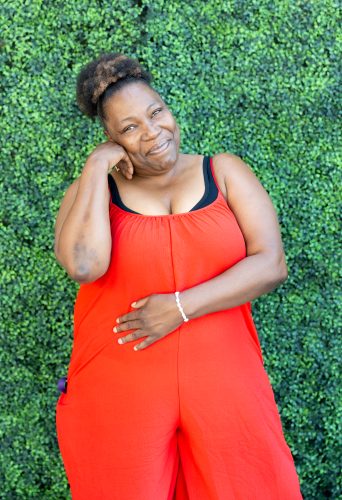
When Pauline talks about leaving Amethyst Place the first time, she does not describe it as failure.
She describes it as thinking she was ready. From the outside, she looked ready too.
She had worked hard. She had maintained recovery. She was moving forward. But there was something happening underneath that she had not fully acknowledged yet.
“I was succeeding. On the outside, in front of everybody else, I was beautiful,” she said. “But inside myself, I had the doubts and the fears and the what ifs.”
Pauline grew up in rural Missouri. She experienced things no child should have to experience. Substances became a way of numbing the pain.
Recovery would eventually ask her to do something much harder than stopping substance use.
It would ask her to feel.
After leaving Amethyst Place, Pauline moved to Arkansas to help care for her older brother who fell ill.
She talks about that decision with tenderness.
She loved him.
She wanted to help.
But returning there also brought her back into an environment that felt familiar in difficult ways — patterns of trauma, unresolved pain, and dynamics that reminded her of places in life where substance use had once become part of how she coped.
She had more than a year in recovery.
But this time she was away from the support, community, and structure she had built around herself.
And it happened quickly.
“It just didn’t take but, like, a blink of an eye.”
Not long after, Pauline found herself incarcerated following a probation violation.
She spent 30 days in jail.
Her daughter, Donairia, stayed with family.
When Pauline talks about that month, she does not talk about punishment.
She talks about stillness.
“That was my saving place,” she said. “That was where my true inside transformation started.”
She remembers sitting with emotions she had spent years trying to outrun.
And she remembers realizing something she cannot forget.
“It was like God was allowing me to feel the raw emotions because He wanted me to see that not only do your decisions affect you, but it’s a domino effect. It affects everything around you.”
That realization felt especially heavy when she thought about Donairia.
Her daughter had to live with family while Pauline rebuilt.
Pauline knew she wanted something different.
Not only recovery.
A different way of living.
A different way of mothering.
A different future.
During treatment, one conversation stayed with her.
After hearing Pauline talk about her brother, a counselor told her:
“Your brother is not your responsibility.”
“It offended me,” Pauline said. “But at the same time, it was like a little relief.”
That sentence stayed with her.
She began noticing how often she had confused love with carrying people.
How often she put herself last.
How often she ignored her own needs.
And she started doing something she had not done before.
She started paying attention to herself.
Pauline talks openly now about recognizing different parts of herself.
The younger version who experienced loss and learned to survive.
The version shaped by years of substance use.
And then there is Pauline.
The one she is becoming.
“Pauline… she’s building. She’s doing. She’s going about it. She doesn’t care what the world says. She’s going to do the right thing.”
She says one of the biggest changes this time has been that she stopped trying to look okay.
“You can put on many faces for the world to see, but it don’t mean a hill of beans unless you internalize it and feel it for yourself and know that you can do it.”
When treatment ended, Pauline knew where she wanted to go.
She reached back out to Amethyst Place.
She took a train back to Kansas City.
She reunited with Donairia.
And she started again.
Today, Pauline is preparing for another transition.
As she leveled up in the program and prepared to move into her apartment at Amethyst Place’s new Tracy campus, she was surprised through United Way of Greater Kansas City and the Kansas City Current’s Impact Moment of the Month. KC Current players Clare Gagne and Haley Hopkins helped decorate her apartment and celebrate the moment with her.
But if you ask Pauline, the apartment is not really the point.
The point is what it represents. A place to keep practicing. A place to keep growing. A place to keep becoming.
As Pauline describes life at Amethyst Place:
“I’m basically living my own independent life… I just got some walls around me right now.”
Today she talks about wanting simple things.
A home.
Peace.
Time with Donairia.
The ability to trust herself.
“I want to be successful outside of this. I want to make it in my own home. And I want to be a great mother.”
And when she talks about the future, she does not sound like someone trying to prove anything.
She sounds grateful.
“I didn’t die out there,” she said.
“So, God gave me another chance.”
“And I’m not going to take it for granted. I’m going to take advantage of it.”